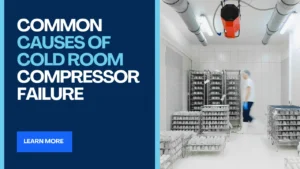
Cold room compressor failure often happens due to overheating, liquid refrigerant going back to the compressor, poor lubrication, refrigerant issues, electrical faults, dirty condensers, short cycling, and system contamination. Many times, the compressor isn’t the main problem. It’s important to find and fix the root issue before replacing it.
Cold room compressors work hard, running for long hours to keep a consistent temperature in places like restaurants, supermarkets, warehouses, butcher shops, or food production areas. Small refrigeration problems can put a lot of stress on the compressor.
Replacing a broken compressor without understanding why it failed can cause the same issues to happen again. Manufacturers warn that problems like liquid refrigerant, lubrication issues, high temperatures, contamination, and unsafe conditions can seriously damage the compressor.
What Causes a Cold Room Compressor to Fail?
Common Causes of Cold Room Compressor Failure:
- Compressor overheating
- Liquid refrigerant returning to the compressor
- Liquid slugging
- Poor lubrication
- Refrigerant leaks or wrong refrigerant charge
- Dirty or blocked condenser coils
- Condenser fan issues
- Problems with the expansion valve
- Electrical supply issues
- High discharge pressure
- Refrigerant movement when the unit is off
- Too much compressor cycling
- Moisture or contamination in the system
- Poor system design or setup
- Not checking earlier compressor failures
Some failures happen suddenly, while others build up over time. For example, a dirty condenser may initially cause longer running times. However, as the pressure increases, compressor temperatures may also rise, damaging oil, insulation, and parts.
That’s why diagnosing compressor issues should consider factors beyond just the compressor itself.
What Does the Compressor Actually Do in a Cold Room?
A cold room compressor circulates refrigerant in the refrigeration system. It takes in low-pressure refrigerant vapour and compresses it to a higher pressure, driving the refrigeration cycle.
After the evaporator absorbs heat inside the cold room, the refrigerant returns to the compressor. The compressor increases the refrigerant’s pressure so it can release heat through the condenser and continue the cycle.
Typically, the refrigerant should be mostly vapour when it reaches most refrigeration compressors. Copeland states that compressors mainly act as vapour pumps. If too much liquid refrigerant enters, it can lead to lubrication loss and mechanical stress.
This is important because many issues labelled as “compressor problems” often stem from other components. A faulty expansion valve, iced evaporator, blocked condenser, incorrect refrigerant charge, or electrical issue can damage the compressor, even if it was working correctly at first.
Compressor Overheating: One of the Biggest Warning Signs
The main reasons for a cold room compressor overheating include high condensing pressure, poor cooling, wrong refrigerant conditions, unusual system load, and high suction-gas temperatures.
A compressor gets warm during regular use, but constant high heat is a problem.
Danfoss identifies high discharge pressure, poor compressor cooling, heavy system load, and frequent starts as possible causes of an overheated compressor.
Why overheating damages compressors
High temperatures can damage different parts of the compressor.
The lubricating oil can break down faster, and electrical components may feel more heat stress. Mechanical parts might not get enough lubrication, and high discharge temperatures can reduce the compressor’s lifespan.
Moisture and air in the refrigeration system can worsen these effects. Danfoss points out that air and moisture can raise condensing pressure and discharge temperatures, and they can also lead to acid build-up and weaken the lubrication.
What may cause a cold room compressor to overheat?
Possible Causes:
- Dirty condenser coils
- Slow or broken condenser fans
- Blocked airflow around the condenser
- High temperatures near the condensing unit
- Refrigerant issues
- Improper expansion valve settings
- High suction-gas superheat
- High discharge pressure
- Wrong compressor type
- Frequent short cycling
- Wear inside the compressor
In a restaurant, a condenser might be near greasy areas. Over time, it becomes dirty.
This dirt prevents heat from escaping, yet the compressor keeps working to keep the cold room cool.
Initially, you may notice the compressor runs longer. Over time, this puts stress on the compressor.
Therefore, cleaning the condenser is very important.
Liquid Refrigerant Floodback Can Destroy Lubrication
Technicians often check for liquid floodback after a refrigeration compressor fails.
What is liquid floodback?
Liquid floodback happens when refrigerant returns to the running compressor from the evaporator before it has fully changed to vapour.
This causes too much liquid refrigerant to enter the compressor.
As a result, it can dilute the oil, reduce lubrication, and, in serious cases, lead to liquid slugging and mechanical failure.
Danfoss warns that continuous floodback can dilute oil and harm lubrication. Copeland notes that too much liquid refrigerant in the compressor can cause significant damage.
What causes refrigerant floodback?
Potential Causes:
- Expansion valve sending too much refrigerant.
- Expansion valve the wrong size.
- Low superheat settings.
- Sensing bulb of the expansion valve not positioned correctly.
- Low airflow in the evaporator.
- Evaporator fan not working.
- Heavy ice build-up on the evaporator.
- Incorrect refrigerant charge.
- Defrost not working properly.
- Sudden changes in refrigeration demand.
- Problems with controls or sensors.
Danfoss notes that high expansion-valve capacity, low superheat settings, and poor sensing bulb contact can lead to liquid hammer or liquid entering the compressor.
It’s important to remember that replacing the compressor won’t solve these issues. If the expansion device keeps flooding the evaporator, the new compressor might also get damaged.
Liquid Slugging Is Different and Potentially More Destructive
Floodback and slugging are related but different.
Floodback happens when liquid refrigerant keeps returning to the running compressor. Slugging occurs when the compressor tries to compress a large amount of liquid, which it cannot do. Compressors are made to compress vapour, not liquid.
When too much liquid enters the compressor, it can create huge mechanical forces. This can damage parts like valves, bearings, rods, and scroll components.
BITZER warns that not enough suction superheat can lead to liquid slugging and bearing washout, while too much floodback can affect proper lubrication.
Signs that should not be ignored
Possible signs include:
- Unusual knocking or hammering sounds
- Foaming oil
- Unstable pressure levels
- Compressor shutdowns
- Abnormal oil levels
- Poor cooling performance
- Frequent compressor damage
These signs need a professional diagnosis, not guessing.
A noisy compressor doesn’t always mean liquid slugging. Wear and tear, mounting issues, and other problems can also cause strange noises.
Poor Lubrication Can Turn Small Problems Into Major Compressor Damage
A compressor needs the right oil, in good condition, circulating and returning correctly. Lubrication reduces friction between moving parts, helps with sealing in some compressor designs, and aids in heat management. If lubrication is low, internal surfaces can overheat and wear out quickly.
BITZER explains that refrigeration compressor oil serves several purposes: lubrication, sealing, and heat dissipation. The manufacturer warns that water contamination can harm oil stability and its ability to lubricate.
Why might a compressor lose lubrication? Possible reasons include:
- Liquid refrigerant mixing with the oil
- Poor refrigerant piping design
- Oil getting trapped in the evaporator
- Low refrigerant speed for returning oil
- Frequent short cycling of the compressor
- Wrong oil amount
- Wrong type of oil
- Refrigerant mixing into compressor oil
- Problems with the oil pump in some designs
- Contamination
- Improper setup after replacing the compressor
Danfoss lists low oil levels, oil pooling in the evaporator, oil boiling in the crankcase, and faulty oil pumps as potential lubrication issues.
More oil is not always the answer
Many people mistakenly think that if the compressor has low oil, they need to add more. This can hide the real problem. If oil is stuck in other parts of the system due to slow pipes or bad design, adding more oil can lead to new problems when the trapped oil comes back. The right approach is to find out where the oil is going and why it isn’t returning as it should.
Dirty Condensers Can Place the Compressor Under Constant Pressure
A dirty condenser can seem like a maintenance problem, not a compressor problem. However, they are closely linked.
The condenser needs to remove heat from the cold room and the heat created during compression. If airflow in an air-cooled condenser is blocked, the refrigeration system may run at higher pressures.
Higher pressures make the compressor work harder. Danfoss points out that very high pressures can cause the compressor to overheat.
What blocks condenser airflow?
Here are common examples of debris that can cause issues:
- Dust
- Grease
- Cardboard fibres
- Packaging waste
- Leaves
- Dirt
- Blocked ventilation openings
- Objects around the condensing unit
Commercial kitchens are especially difficult because grease mixes with dust, creating a tough coating on condenser surfaces. Warehouses also face similar problems with packaging dust and airborne fibers.
What businesses can do?
Keep the area around the condenser clear and check it regularly.
Don’t take off guards, touch electrical parts, or work on refrigerants unless you are trained and authorised.
Have a professional check both the cleanliness and performance of the system, not just wipe away visible dirt from the coil.
Refrigerant Problems Can Make the Compressor Work Outside Normal Conditions
The refrigerant charge needs to be just right for the system.
Too little refrigerant or wrong feeding can cause issues in the refrigeration cycle.
For example, Danfoss points out that a low refrigerant charge and problems in liquid-line components can lead to very high suction-gas temperatures.
What happens when refrigerant is low?
A refrigerant leak can cause:
- Weak cooling
- Longer compressor running times
- Low suction pressure
- High superheat
- Higher compressor temperatures
- Problems with the evaporator
The compressor might keep running to meet the temperature control. This does not mean the compressor is broken.
What about too much refrigerant?
Incorrect charging can cause issues.
Too much refrigerant can lead to high pressures or liquid management problems, depending on the system and conditions. That’s why adding gas without checking the cause of refrigerant loss is a bad practise.
Refrigerant doesn’t usually vanish in a sealed system. If it’s lost, you should check for leaks or other problems.
Businesses with ongoing cooling issues should get a professional assessment for Cold Room Repair in Birmingham. This should focus on checking pressures, temperatures, refrigerant condition, and the entire refrigeration circuit instead of just assuming the compressor needs replacing.
Electrical Faults Can Damage an Otherwise Healthy Compressor
Not all compressor failures start with refrigeration issues. Electrical conditions are also important.
Cold-room compressors need the right electrical supply, protection devices, and controls. Bad voltage can shorten the equipment’s life, especially in three-phase systems.
Danfoss suggests checking the voltage across all three phases for three-phase compressors. An improper power supply can significantly reduce the compressor’s life expectancy.
Electrical problems may include:
- Low voltage
- Excessive voltage
- Phase imbalance
- Phase loss
- Loose terminals
- Damaged contactors
- Burnt connections
- Faulty overload protection
- Repeated starting
- Incorrect wiring
- Motor winding faults
A compressor can shut down even if the refrigeration system looks fine at first.
Why electrical diagnosis matters
Resetting a tripped compressor without checking why it tripped can worsen the issue.
A protection device trips for a reason.
For instance, a compressor might draw too much current because it faces too much pressure. It may also overheat due to an imbalance in voltage.
It’s important to assess both the refrigeration and electrical aspects of the system together.
Short Cycling: When the Compressor Starts and Stops Too Often
A healthy compressor shouldn’t start and stop every few minutes during normal use, unless it’s designed for that.
Short cycling is when the compressor turns on and off too often.
Frequent starts can put extra strain on both mechanical parts and electrical systems.
BITZER warns that very short operating times can disrupt oil return. Oil may exit the compressor during startup but might not have enough time to come back before the compressor stops again. Repeated cycles can gradually reduce the oil in the compressor.
Why does a cold room compressor short cycle?
Possible causes include:
- Incorrect thermostat differential
- Faulty temperature sensor
- Low refrigerant charge
- High-pressure safety trips
- Low-pressure safety trips
- Oversized equipment
- Dirty condenser
- Condenser fan faults
- Incorrect control settings
- Rapid changes in refrigeration load
- Electrical control faults
A real-world example
Picture a cold room in a convenience store. The compressor starts, runs for two minutes, then stops. It begins again after a few minutes. The room stays cold, so this behaviour is overlooked.
Over several months, the repeated starts wear down the compressor. Short running times may also prevent oil from returning properly.
When the compressor finally breaks down, it seems sudden. But the warning signs may have been there for months.
Expansion Valve Problems Can Eventually Become Compressor Problems
The expansion device controls the amount of refrigerant that enters the evaporator.
If it lets in too little refrigerant, the evaporator won’t get enough.
If it lets in too much, liquid refrigerant could go back to the compressor.
This is why the expansion valve must work correctly for the compressor to be reliable.
Too little refrigerant feeding
A starved evaporator can lead to:
- Bad cooling
- High superheat
- Low suction pressure
- Long running times
- High compressor discharge temperature
Too much refrigerant feeding
Overfeeding can cause:
- Low superheat
- Floodback
- Oil dilution
- Liquid slugging
- Compressor protection trips
Danfoss suggests checking superheat, valve size, sensing-bulb position, refrigerant compatibility, and restrictions when diagnosing cold-room expansion valve issues.
After replacing a compressor, it’s important to conduct a thorough root-cause investigation beforehand or afterwards.
Refrigerant Migration Can Damage a Compressor Before It Even Starts
A compressor can face problems when the system is off. This is known as refrigerant migration. When the system shuts down, refrigerant vapour can move to the coldest part of the system. If this part is the compressor, the refrigerant can turn into liquid and mix with the oil.
When the compressor restarts, the refrigerant can quickly boil out of the oil. This causes foaming and oil dilution, which can lower lubrication when the bearings and other parts are under stress. Copeland notes that this issue, often linked to flooded starts, is different from normal running floodback.
Depending on the system design, protective measures can include proper pump-down setups, crankcase heaters, or suction accumulators. These should be decided by professionals, not done as DIY fixes.
Moisture, Air and Contamination Can Kill the Replacement Compressor
A compressor failure is critical to address. If the old compressor had an electrical burnout or major mechanical damage, dirt and debris might be left in the refrigeration system.
Putting in a new compressor without cleaning the system can lead to the same contamination affecting the new unit. Danfoss warns that leftover contamination from a failed compressor can cause the new one to fail early.
What can contamination do?
Depending on the type of contaminant and the system, it can lead to:
- Acid formation
- Oil breakdown
- Clogged filters
- Issues with the expansion valve
- Damage to motor insulation
- Corrosion
- Mechanical wear
- Less lubrication
Moisture can cause serious harm. BITZER warns that water in the refrigeration system can cause corrosion, affect oil stability, create acids with some refrigerants and oils, and may freeze in expansion parts.
Therefore, proper evacuation, dehydration, managing filter-driers, and keeping the system clean are very important during repairs.
Why Does My Cold Room Compressor Keep Failing?
If you’re wondering, “Why does my cold room compressor keep breaking?”, frequent failures indicate you should check the system’s condition.
Replacing the compressor only fixes the broken part. It doesn’t solve the main issue. The root problem might be:
| Repeated symptom | Possible underlying issue |
| Compressor continually overheats | Dirty condenser, fan fault, high discharge pressure, excessive superheat |
| Bearings repeatedly fail | Poor oil return, floodback, oil dilution |
| Compressor fails shortly after replacement | Contamination, incorrect commissioning, unresolved system fault |
| Compressor keeps tripping | Electrical problem, overload, pressure problem, overheating |
| Compressor makes hammering noises | Possible liquid return or slugging |
| Compressor repeatedly short cycles | Control fault, refrigerant issue, pressure switch or sizing problem |
| Compressor runs almost constantly | Cooling-load issue, refrigerant problem, dirty coils, door or insulation problems |
The investigation should ask:
What caused the compressor to break?
This is more useful than just asking:
Is the compressor broken?
If a cold room consistently loses temperature or the compressor frequently shuts down, getting Commercial Cold Room Repair in Birmingham can help find out if the problem is with the compressor, condenser, evaporator, expansion device, controls, electrical supply, or refrigerant circuit.
Warning Signs a Cold Room Compressor May Be in Trouble
Signs of Compressor Issues
Compressor problems don’t always show clear warnings. Often, the first sign is a cold room that takes longer to warm up.
Watch for these changes:
- Room temperature slowly increasing
- Compressor running nonstop
- Frequent starts and stops of the compressor
- Odd knocking, clicking, or humming sounds
- Compressor protection tripping often
- Condensing unit getting too hot
- Ice in unusual spots
- Higher electricity bills without explanation
- Oil leaks
- Refrigerant leaks
- Condenser fan not working right
- Cold room taking a long time to cool after loading
- Temperature changes a lot
- Strong burning or electrical smell near the equipment
None of these signs alone mean the compressor has failed. For example, poor temperature could be due to icing, airflow issues, or damaged door seals, not just the compressor. A hot compressor doesn’t necessarily mean it’s broken. An experienced engineer will look at everything to understand the problem.
How Engineers Diagnose Cold Room Compressor Failure Step by Step
A good compressor diagnosis must be organised. Just hooking up gauges and saying the compressor is broken isn’t sufficient.
Step 1: Confirm the actual complaint
The engineer starts by figuring out what the system is doing.
Is the cold room:
- Fully warm?
- Cooling slowly?
- Short cycling?
- Tripping?
- Making strange noises?
- Losing temperature only when busy?
The operating pattern offers important hints.
Step 2: Inspect the cold room itself
The refrigeration unit might be fine, but heat can still come in from other places.
To check this, look at:
- Door closure
- Door seals
- Insulation condition
- How products are loaded
- Airflow from the evaporator
- Ice build-up
- Fan operation
Step 3: Inspect the condenser
The engineer looks for:
- Dirt
- Blocked airflow
- Fan issues
- High temperature
- Physical damage
Step 4: Check refrigeration operating conditions
Measurements can include:
- Suction pressure
- Discharge pressure
- Suction-line temperature
- Discharge temperature
- Superheat
- Subcooling
- Refrigerant condition
These readings show if the compressor is working properly.
Step 5: Check electrical conditions
Voltage, current, connections, contactors, phase conditions, and protective devices need inspection.
Step 6: Check lubrication and refrigerant return.
Look at the oil condition, oil level, and any signs of floodback or migration. This could give important clues.
Step 7: Find the main issue before replacing parts.
If the compressor has truly failed, determine why. Only then should you replace it.
Businesses that need thorough diagnostics can use professional Cold Room Repair Services in Birmingham to check the entire cold-room system instead of fixing each problem one by one.
How to Prevent Compressor Failure in a Cold Room
A compressor may fail, but proper care can reduce stress on it.
1. Keep Coils Clean
Dirty coils can trap heat and raise pressure. Clean them regularly, especially in busy areas like kitchens.
2. Clear Airflow Paths
Don’t block condensing units with boxes or equipment. Warm air needs space to escape.
3. Watch for Unusual Cycling
If the compressor starts up more often than usual, check it. This isn’t normal.
4. Fix Refrigerant Leaks
If refrigerant leaks, find and fix the source. Just adding more refrigerant won’t solve the problem.
5. Maintain Evaporator Airflow
Blocked or icy evaporators can disrupt refrigerant flow and lead to issues.
6. Check Expansion Control
Ensure the refrigerant flow and superheat levels are correct to avoid liquid returning to the compressor.
7. Monitor Operating Conditions
Regularly check pressure, temperature, and electrical current to catch problems early.
8. Inspect Electrical Parts
Look for loose connections or damaged parts. Don’t ignore them.
9. Use Proper Refrigerant and Oil
Make sure the refrigerant and oil are right for your compressor and system.
10. Maintain the Whole Cold Room
Good care for the compressor includes checking door seals, insulation, fans, and sensors. They all affect the system’s workload.
Cold Room Compressor Maintenance Tips for Business Owners
Business owners should avoid doing refrigeration repairs themselves, but they can take steps to spot problems early.
Daily Checks
Watch for:
- Cold-room temperature
- Temperature changes
- Strange noises
- Unusual smells
- Ice build-up
- Doors that don’t close right
- Water leaks
- Blockages in the condenser area
Keeping simple temperature records can help you notice changes in performance over time.
Keep stock correctly arranged
Do not block the evaporator airflow with boxes or pallets. Cold air needs to move around the room.
2. Close the door:
Avoid leaving the door open for too long. Opening the door too often lets warm, moist air inside. The system then has to work harder to remove this heat and moisture.
3. Watch for changes:
Don’t ignore small issues. If a cold room takes 20 minutes longer to cool down, it might seem minor but can signal bigger problems like:
- Dirty heat exchangers
- Loss of refrigerant
- Fan issues
- Defrost problems
- Worn door seals
- Failing compressor
Fixing these issues early is better than waiting for the cold room to stop working.
Common Mistakes That Can Make Compressor Problems Worse
Mistake 1: Replacing the compressor without finding the cause
This is the biggest mistake. If the first compressor failed due to liquid floodback, poor oil return, contamination, or high condensing pressure, the new compressor is still at risk.
Mistake 2: Thinking every cooling issue is a gas problem
Low refrigerant is just one possible issue. Adding refrigerant when it’s not needed can cause more problems.
Mistake 3: Resetting trips repeatedly
High-pressure, low-pressure, and overload protection are important. Resetting without checking can harm the equipment.
Mistake 4: Ignoring dirty coils
Dirty condenser and evaporator coils can affect how well the system runs.
Mistake 5: Assuming strange compressor noises are normal
New noises should be checked out.
Mistake 6: Blocking the condensing unit
Obstructions around the condenser can limit airflow significantly.
Mistake 7: Waiting for the cold room to warm up completely
Temperature issues often get worse before total failure. This is a good time to diagnose the problem.
Expert Tips: Protecting a Cold Room Compressor for the Long Term
Look for patterns, not isolated symptoms
If compressors trip only on hot afternoons, check the condenser performance and condensing pressure.
If problems occur right after defrost, look into refrigerant control and liquid return.
Identifying patterns can help find the causes.
Record unusual behaviour
When the problem happened, note the following:
- The room temperature
- If the door was open
- If the compressor was running
- If the fans were running
- If the system had just defrosted
This information can help diagnose the issue faster.
Do not overlook the environment
Refrigeration systems do not function well in lab-like conditions.
Kitchen grease, dust, packaging, high temperatures, and poor ventilation can all affect performance.
Look into repeat failures closely.
If a second compressor fails, question the surrounding system immediately.
Manufacturers say issues like unsafe conditions, lubrication problems, liquid refrigerant, and contamination can damage compressors.
Use preventative maintenance wisely.
Good maintenance is more than just a checklist; it should spot changing conditions before they cause costly failures.
Businesses that rely on temperature-controlled storage can benefit from scheduled cold room repairs and maintenance in Birmingham, helping to find problems before they lead to major downtime.
Repair or Replace the Compressor: Which Makes More Sense?
Not all broken refrigeration systems need a new compressor. Often, the issue looks like it’s the compressor, but the real problems could be:
- A bad start component
- An electrical contactor issue
- A faulty sensor
- A pressure control problem
- A refrigerant issue
- A faulty expansion valve
- A condenser problem
If the compressor has a serious electrical or mechanical failure, you might need to replace it. Consider the following before deciding:
| Consideration | Why it matters |
| Compressor condition | Determines whether repair is technically possible |
| Age of refrigeration system | Older systems may have additional worn components |
| Refrigerant type | May affect long-term repair strategy |
| Cause of failure | Must be corrected before replacement |
| Condition of condenser and evaporator | Other major components may also be deteriorating |
| Repair cost | Compare with wider system upgrade costs |
| Cold-room importance | High-risk storage may justify greater reliability investment |
| Energy performance | Older equipment may cost considerably more to operate |
The cheapest quick fix isn’t always the best long-term choice. Similarly, replacing the whole refrigeration system when only one part is broken might not be needed. First, we should diagnose the problem.
People Also Ask About Cold Room Compressor Failure
What is the most common reason a cold room compressor fails?
There isn’t just one reason for compressor problems. Common causes are overheating, lubrication issues, liquid refrigerant flooding, electrical faults, high discharge pressure, refrigerant problems, and contamination. Manufacturers stress the dangers of liquid refrigerant and lubrication loss, as both can seriously damage the compressor.
Why Is My Compressor Overheating?
Reasons for overheating may include dirty condenser coils, poor airflow, broken fans, high condensing pressure, high suction-gas temperature, system overload, or frequent cycling. Check actual pressures and temperatures instead of relying solely on the compressor’s surface temperature.
Can Low Refrigerant Hurt the Compressor?
Low refrigerant can cause poor performance, high superheat, long compressor runtimes, and increased temperature. Find and fix the leak instead of just adding more refrigerant.
Can Too Much Refrigerant Damage the Compressor?
An incorrect refrigerant charge can distort pressures and control. It may lead to liquid management issues or excessive pressure. Always follow the manufacturer’s refrigerant guidelines.
What Happens If Liquid Refrigerant Enters the Compressor?
Too much liquid refrigerant can mix with compressor oil, reducing lubrication. This can cause slugging, which puts mechanical stress on the compressor since it is designed to compress vapour, not liquid.
How Can I Tell If My Compressor Is Failing?
Signs of a failing compressor include poor cooling, strange noises, frequent trips, long running times, excessive cycling, electrical issues, and high temperatures. These signs may also point to other refrigeration problems, so a professional should check it first.
How Long Should a Compressor Last?
A compressor’s lifespan varies based on its use, maintenance, and operating conditions. A well-maintained compressor in good conditions can last much longer than one that suffers from overheating, flooding, or frequent cycling.
Can a Dirty Condenser Cause Failure?
Yes, indirectly. A dirty condenser can block heat rejection, leading to high pressure and temperature, which increases stress on the compressor over time.
Should I Replace a Trip-Triggered Compressor?
Not necessarily. A trip means a safety device has activated due to issues like temperature, current, or pressure. Diagnose the cause first; the compressor may still be fine.
Why Did My Replacement Compressor Fail Again?
Repeated failures often indicate an unresolved refrigeration or electrical issue. Possible reasons include contamination from previous problems, liquid floodback, poor oil return, high discharge temperatures, incorrect setup, or electrical supply issues.
A Failed Compressor Is Often the End of the Story, Not the Beginning
When a cold room compressor fails, it’s easy to blame the compressor. However, it usually comes at the end of a series of issues.
A dirty condenser raises the pressure. A failing fan doesn’t release heat well. An improperly working expansion valve sends liquid back to the compressor. Short cycling prevents proper oil return. Moisture harms oil quality. An electrical problem overheats the motor. Eventually, the compressor breaks down.
To avoid future failures, it’s important to understand these issues. Instead of just replacing the compressor, figure out what caused the failure, fix it, and ensure the system works safely.
For Birmingham businesses that need cold storage, UK Freez Solutions offers diagnostics and repair for refrigeration issues, including temperature problems, leaks, and compressor or condenser failures.
If your compressor is overheating, shutting off often, making strange noises, or has already broken down, schedule a professional inspection. This can help prevent further downtime and protect your stored products.