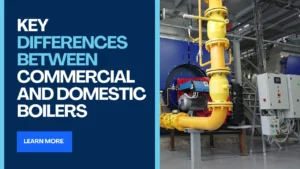
The main difference between commercial and domestic boilers is their heating needs. Domestic boilers heat individual homes, while commercial boilers meet the greater demands of offices, hotels, schools, warehouses, restaurants, and other businesses.
Choosing the right boiler isn’t just about size. A proper comparison should look at the building’s heat load, hot-water needs, usage patterns, zoning, existing pipes, controls, ventilation, flue setups, and the need for reliable heating.
Homeowners usually choose a domestic combi system or heat-only boiler that fits their house. Business owners, however, might need a larger unit, several boilers working together, separate hot-water systems, or a more advanced plant-room setup.
What Is the Main Difference Between Commercial and Domestic Boilers?
Domestic boilers heat homes and provide hot water, while commercial boilers cater to larger buildings with higher heating needs.
Key differences between commercial and domestic boilers include:
- Heating output and system capacity
- Number of rooms or zones heated
- Amount of hot water needed at once
- Daily operating hours
- Boiler controls and management needs
- Pipework, pumps, and design requirements
- Space and ventilation needs
- Access for maintenance
- Redundancy and backup heating
- Installation and setup complexity
- Efficiency and Building Regulations compliance
A small office may not need a commercial boiler, just as a large house doesn’t require the same heating setup as a typical three-bedroom home. The right system is determined by assessing the property and calculating its heating and hot-water needs.
What Exactly Is a Domestic Boiler?
A domestic boiler provides central heating and hot water for homes. It is used in various types of residential buildings like flats, terraced houses, and detached homes.
In the UK, homeowners commonly use three types of boilers: combi, system, and heat-only. A combi boiler offers heating and hot water without needing a separate hot-water tank, while system and heat-only boilers require stored hot water. The best choice depends on the property’s size, number of bathrooms, water pressure, available space, and hot-water needs.
Modern domestic boilers are usually compact. Controls may include room thermostats, programmers, thermostatic radiator valves, smart thermostats, and weather compensation, depending on the setup.
For those thinking about replacing their boiler, professional boiler installation services in Birmingham can help determine whether a combi, system, or heat-only boiler is best for the home, rather than simply replacing the old one with a similar model.
Choosing a boiler should start by considering the home, not just the catalogue. A highly rated boiler can underperform if it is too big, poorly controlled, or not connected to a properly assessed heating system.
What Is a Commercial Boiler?
A commercial boiler heats non-domestic buildings or properties that need more heat than a typical home system. You can find these systems in places like:
- Offices
- Hotels
- Schools
- Restaurants
- Retail shops
- Care facilities
- Apartment buildings
- Warehouses
- Workshops
- Leisure centres
- Places of worship
- Large mixed-use buildings
The term “commercial” refers to heating needs, not just the type of building. A small shop with low heating needs will use different equipment than a large hotel with many radiators and constant hot water. Similarly, a warehouse with a small heated office will have different needs than a care facility that requires heat and hot water all day.
Larger setups often use several boilers rather than one big unit. This is called a cascade or modular boiler system. Multiple boilers can turn on and off as needed, providing better flexibility and reliability if designed correctly.
Businesses looking to replace or install a new boiler should assess the entire heating system. UK Freez Solutions offers Commercial Boiler Installation in Birmingham, focusing on heating output, controls, and overall system design rather than treating the boiler as a separate piece of equipment.
Commercial Boiler vs Domestic Boiler Comparison at a Glance
To understand the difference between commercial and domestic boilers, it helps to compare the systems they work in.
| Factor | Domestic Boiler | Commercial Boiler/System |
| Typical application | Houses and flats | Offices, schools, hotels, shops, warehouses and larger buildings |
| Heating demand | Usually relatively modest | Often higher or more complex |
| Operating pattern | Morning, evening and household schedules | May operate for long business hours or continuously |
| Hot-water demand | Kitchens, showers and bathrooms | May include multiple washrooms, kitchens, showers or process demand |
| Number of heating zones | Usually limited | Potentially many rooms, floors or operating zones |
| Controls | Thermostats, programmers, smart controls | Advanced zoning, sequencing and sometimes BMS integration |
| Boiler arrangement | Often one boiler | Single boiler or multiple boilers in cascade |
| Pumps and hydraulics | Relatively straightforward | Can involve multiple circuits, pumps, headers and mixing arrangements |
| Installation environment | Kitchen, utility room, loft or airing cupboard | Often dedicated plant room or service area |
| Downtime consequences | Loss of household heating/hot water | May disrupt staff, customers, tenants or business operations |
| Maintenance planning | Residential servicing schedule | Often planned around operating hours and business continuity |
| System design | Individual household | Whole-building heating strategy |
This table shows an important point: comparing commercial boiler capacity to domestic boiler capacity is just one aspect.
The difference also depends on the equipment around the boiler. Commercial systems may include multiple pumps, low-loss headers, plate heat exchangers, motorised valves, pressurisation units, calorifiers, expansion equipment, zoning controls, and building management systems.
So, looking at boiler output alone can be misleading.
Commercial Boiler Capacity vs Domestic Boiler Capacity
Capacity is one of the first differences people notice, but it’s easy to oversimplify.
Home boilers are sized based on the heating and hot-water needs of the house. A typical home often requires only a small part of the boiler’s maximum output for heating, especially if a combi boiler is used for quick hot water.
Commercial properties usually need much more heat. They often have larger areas, higher ceilings, more ventilation loss, more people, and multiple heating zones. They also often require a lot of hot water at once.
Why bigger is not automatically better
Using a boiler that’s too big can cause problems. If the boiler is much larger than needed, it may turn on and off too often, especially in mild weather. This can lower efficiency and wear out parts faster.
Engineers should measure heat loss instead of just picking a boiler with a higher kilowatt number. Key factors to consider include:
- Building size
- Insulation quality
- Window size
- Air leaks
- Ventilation
- Number of people
- Desired temperatures
- Radiator size
- Hot-water needs
- Heating schedule
- Future changes to the building
For larger buildings, engineers should also think about peak demand. Not every area will need maximum heat at the same time.
Commercial capacity may be divided between boilers
Instead of one big boiler, a commercial building can use several smaller boilers lined up in a row.
For instance, rather than running one boiler at full power all year, several boilers can work based on how much heat is needed. In mild weather, only some boilers run. On a cold morning, more boilers can start up to provide extra heat.
The setup varies based on the building and control system. This shows that the difference between commercial and home boilers is more about design than just size.
Operating Hours Change Everything
One key difference between commercial and domestic boilers is the duty cycle.
A domestic boiler typically runs at different times during the day. It may heat water in the morning, again in the evening, and more often during cold weather.
In contrast, commercial buildings have different needs. A hotel needs heating and hot water all the time. Care facilities must keep comfortable temperatures 24/7. Schools often require a lot of heating in the morning. Restaurants need heat and hot water during service hours.
These usage patterns affect:
- Boiler size
- Control system
- Pump choice
- Component lifespan
- Maintenance schedules
- Energy use
- Back-up plans
A boiler that seems right based on space alone may not be suitable when you consider how many hours it will actually operate.
Business downtime has a different cost.
A broken domestic boiler can cause discomfort.
When a business heating system fails, it affects more people. Employees may be uncomfortable, customers might leave, hotel guests could complain, and tenants may report lost services. Some businesses may even have to limit their activities without heating or hot water.
That’s why commercial heating design focuses on being resilient. Depending on the location, this might include using multiple boilers, separate heating systems, regular maintenance, or controls that keep parts of the system working while others are shut down.
If a business heating system loses pressure, shows error codes, heats unevenly, or keeps shutting off, getting Commercial Boiler Repair services in Birmingham can help find the problem before it leads to bigger issues.
Hot-Water Demand Can Be More Important Than Floor Area
Many people think about how many square metres a boiler needs to heat. However, hot water is also important when choosing between a commercial and a domestic boiler for a business.
Let’s look at two similar-sized buildings. The first is a small office with ten employees, a few sinks, and a kitchenette. The second is a beauty salon with multiple treatment rooms that uses a lot of hot water. Even if their heating needs are alike, their hot-water needs can differ greatly.
A hotel is another clear example. In the mornings, many guests may shower in a short time, needing a hot-water system that can handle peak demand, storage, recovery time, and distribution.
Why domestic combi assumptions can cause trouble
Combi boilers are great for many homes because they supply hot water without needing a separate tank. However, they aren’t suitable for every small business. If multiple taps need hot water at the same time, engineers must check if the boiler and water supply can meet the demand.
Instead, businesses might use stored water systems, dedicated water heaters, or other setups based on their needs. The choice should depend on actual hot water usage, not just whether the boiler fits in a cupboard.
Commercial Heating System Requirements Are More Complex
When people look for the best boiler for commercial buildings, they usually want a list of models. However, a better question is:
What heating system does this building actually require?
The performance of a commercial boiler relies on the entire heating system. This system includes:
- Boiler sequencing
- Primary and secondary circuits
- Pump arrangements
- Hydraulic separation
- Expansion vessels
- Pressurisation equipment
- Water treatment
- Heating zones
- Motorised valves
- Weather compensation
- Building management systems
- Hot-water storage
- Flue design
- Ventilation
- System monitoring
A boiler alone cannot fix major problems in the system. For example, putting a modern boiler into an unbalanced system may cause some areas to overheat while others stay cold. Also, old controls might keep the heating on in empty rooms.
Zoning becomes particularly important
A house usually has one or two main heating areas.
A commercial building can have very different spaces.
Think about a three-story office. The ground-floor reception often opens to cold air outside. Meeting rooms are used sometimes. The server room may need cooling instead of heating. The top floor gets more heat from sunlight.
Heating all these areas the same way can waste energy.
Commercial controls can split the building into zones and change heating schedules as needed.
This control is why a commercial heating project is more than just the boiler.
Controls: From Smart Thermostats to Building Management Systems
Controls are a key part of comparing commercial and domestic boilers.
Domestic heating controls are made for easy home use. They often include:
- Programmable thermostats
- Smart thermostats
- Thermostatic radiator valves
- Separate controls for heating and hot water
- Weather compensation
- Load compensation
These technologies help homeowners manage their heating effectively, but commercial buildings typically require more advanced options.
What commercial controls may manage
A large building may need to manage:
- Multiple heating zones
- Several boilers
- Different floors
- Varying occupancy schedules
- Flow temperatures
- Pump operations
- Hot water production
- Frost protection
- Night setback temperatures
- Holiday schedules
Large properties often use a Building Management System (BMS) to control heating. A BMS allows staff to monitor temperatures, schedules, equipment status, and alarms. This is important for saving energy, as poor control can waste a lot, even with efficient boilers.
Commercial Boiler Efficiency and Running Costs
When discussing commercial boiler efficiency, we should focus more on real energy use instead of just efficiency percentages.
Efficiency is important, but actual energy use depends on the building, the system, and how the equipment is managed.
Many factors affect running costs, including:
- Insulation quality
- Heat loss
- Boiler efficiency
- Boiler sizing
- Flow temperature
- Return temperature
- Heating schedules
- Occupancy
- Zoning
- Electricity use for pumps
- Hot-water demand
- System balancing
- Maintenance condition
- Weather adjustments
- Building usage
An efficient boiler that is poorly controlled can still waste fuel. In contrast, a well-designed system provides heat only where and when it’s needed, reducing waste.
Condensing operation matters
Modern gas boilers often use condensing technology. This technology captures extra heat from the gases produced when the boiler burns fuel. However, the stated efficiency of the boiler does not reveal everything. Factors like system temperatures, controls, and heat emitters affect real performance.
Commercial systems should look at the entire operating strategy to improve energy use, especially since small percentage gains can save money when energy usage is high. In England, non-domestic buildings must follow specific energy-efficiency guidelines in Approved Document L. The 2026 version divides guidance into Volume 1 for homes and Volume 2 for other buildings, highlighting that domestic and commercial heating projects require different approaches.
Installation Requirements Differ More Than Most People Expect
Replacing a domestic boiler often requires considerable engineering work, especially if the boiler’s location changes or if the heating system needs an upgrade.
Commercial projects are usually more complex and may need an assessment of:
- Plant-room layout
- Boiler access
- Gas supply capacity
- Flue route
- Ventilation
- Drainage
- Electrical supply
- Controls
- Pipework
- Pumps
- Expansion arrangements
- System water
- Heat distribution
- Maintenance clearances
The engineer must also plan the work to minimise disruption to the organisation.
Commercial plant rooms require planning
A commercial boiler is just one part of a plant room. If you replace it without understanding the other equipment, it could cause problems. The existing pumps might not work with the new boiler, and old control panels may need changes. The pipe sizes and layout might also need to be reassessed.
Because of this, starting with a site assessment is crucial when replacing a commercial boiler. UK Freez Solutions explains that its installation process includes site assessment, system design, boiler selection, installation, safety checks, commissioning, and handover.
For a home, the process is simpler but still important. The engineer must check the heating system, pipes, hot-water needs, and controls instead of treating the new boiler like just a plug-in appliance.
Do Commercial Boilers Have Different UK Safety Requirements?
Gas Safety Overview
Gas safety is important for both homes and some businesses. The Health and Safety Executive provides rules for gas installation, servicing, maintenance, and repair under the Gas Safety (Installation and Use) Regulations 1998.
Only qualified people can do gas work. Property owners and businesses should check that an engineer is Gas Safe registered and has the right qualifications for the specific gas work and appliances involved.
It’s important to note that being “Gas Safe registered” does not mean every engineer is skilled in all types of equipment. Commercial gas work may require different skills than residential work.
Building Regulations also matter
Heating installations must meet Building Regulations. GOV.UK lists installing or replacing a heating system as work needing approval or compliance.
England’s energy-efficiency rules are in Approved Document L.
There are different guidelines for residential and commercial buildings because they use energy differently.
Businesses should not assume they can scale up a domestic installation approach for commercial use.
Can You Use a Domestic Boiler for Small Commercial Premises?
Sometimes, using a domestic boiler for small commercial sites is appropriate, but it depends on factors like the appliance, system design, manufacturer guidelines, and installer skill.
One common question is whether a domestic boiler is suitable for a small office. For example, a small office converted from a house might have three offices, a reception area, a restroom, and a kitchenette. Its heating needs may be more like a home than a larger commercial building like a warehouse or hotel.
In this case, the building might not need a high-capacity boiler used by bigger companies. However, the engineer must evaluate several factors, including:
- Heat loss calculations
- Hot water requirements
- Operating hours
- Number of people in the building
- Existing heating system
- Boiler manufacturer specifications
- Gas supply
- Flue and ventilation systems
- Usage type
- Engineer qualifications
Just because a building is small doesn’t mean any domestic boiler will work.
A business address does not determine boiler type by itself
This is important to remember because it can avoid a costly error.
A commercial property doesn’t always need a large commercial boiler.
Choosing a domestic boiler just because it looks cheaper isn’t a good idea.
The right choice depends on the design of the heating system.
So, instead of immediately asking, “Should I use a commercial or domestic boiler for my business?” focus on assessing the heat load and demand first.
When Does a Commercial Boiler System Make More Sense?
A specially designed commercial heating system becomes more important as heating needs grow and become more complex.
Here are some signs that a commercial system is needed:
- Large floors
- Multiple stories
- Many heating areas
- High hot-water demand at peak times
- Long operating hours
- Multiple tenant spaces
- Need for centralised controls
- Back-up capacity requirement
- Big plant room
- Several heating circuits
- Critical heating for the business
Consider a medium-sized hotel. Its rooms need heat, and showers create high hot-water demand, especially in the morning. Reception and common areas run for long hours, and kitchens and housekeeping add more demand. A standard household heating solution might not meet these needs efficiently or reliably.
A well-designed commercial heating system can use several boilers, dedicated hot-water equipment, and separate heating zones to balance the load. The specific arrangement will depend on the building, but the goal is the same: provide enough heating and hot water without wasting fuel or adding unnecessary complexity.
Real-World Scenarios: Which Boiler Would Suit Each Property?
Seeing real examples makes it easier to understand the difference between commercial and home boilers.
Scenario 1: Three-bedroom Birmingham home
A family has one bathroom and a moderate need for hot water. They already have a radiator system, so this is mainly for heating their home. Based on water pressure, usage, and the home’s layout, a suitable combi boiler can provide heating and hot water without a cylinder. If their current boiler keeps losing pressure, shutting down, or not heating properly, they should consider Domestic Boiler Repair services in Birmingham before deciding to replace it.
Scenario 2: Large five-bedroom house with three bathrooms
This is a home, but it needs more hot water.
A system boiler with a properly sized hot-water tank might work better than a standard combi boiler.
The key takeaway is that hot water needs can differ greatly even in homes.
Scenario 3: Small accountancy office
A converted building has six employees, one kitchenette, and regular working hours.
Its heating needs might be small so that a simple system could work.
The engineer must still check the commercial use, operating hours, and whether the equipment is suitable.
Scenario 4: Restaurant
The restaurant needs heating, hot water for bathrooms, and a lot of hot water for the kitchen. The highest demand may be much more than just the size of the building indicates. A survey should check how much heating and hot water is used.
Scenario 5: Hotel
A hotel has bedrooms, bathrooms, common areas, and operates for long hours. It can use multiple boilers, stored hot water, and advanced controls. It’s crucial to be resilient, as losing heating or hot water can greatly impact guests and operations.
Scenario 6: Warehouse
A hotel has bedrooms, bathrooms, common areas, and operates for long hours. It can use multiple boilers, stored hot water, and advanced controls. It’s crucial to be resilient, as losing heating or hot water can greatly impact guests and operations.
Commercial Boilers Often Need More Sophisticated Maintenance Planning
Both home and commercial boilers need regular maintenance. However, neglecting them has different consequences.
Homeowners usually schedule maintenance at their convenience. In contrast, facilities managers must fit maintenance around production schedules, office use, hotel bookings, or customer hours.
Commercial systems often have more parts to maintain, including:
- Boilers
- Burners
- Pumps
- Valves
- Pressurisation units
- Expansion vessels
- Heat exchangers
- Controls
- Sensors
- Flues
- Water treatment equipment
The HSE advises that good gas appliance maintenance includes regular inspections and any needed repairs.
Planned maintenance can reduce disruption
A commercial heating system usually breaks down at the worst time. Issues often show up during the first cold snap when boilers work harder, and demand for heat rises quickly. Regular inspections can find worn parts, combustion problems, pressure issues, or control faults before they worsen. For businesses, this isn’t just about making the boiler last longer; it’s also about lowering operational risks.
Common Mistakes When Comparing Commercial and Domestic Boilers
Picking the wrong heating system can lead to big problems for years. Here are some common mistakes to avoid.
Mistake 1: Selecting purely by boiler output
A high kilowatt number doesn’t always mean better heating. The boiler must fit the calculated needs and the system it supports.
Mistake 2: Assuming every business needs a commercial boiler
Small commercial spaces usually need less heating. It’s better to evaluate the building itself instead of just looking at its location or type of business.
Mistake 3: Installing a domestic boiler because it costs less
A lower initial cost does not mean the system is suitable. If the boiler has to work harder than planned or can’t meet peak demand, any savings may vanish due to poor performance or early replacement.
Mistake 4: Ignoring hot-water demand
Bathrooms, washrooms, kitchens, and showers can significantly change the needs for boilers and storage.
Mistake 5: Ignoring controls
A good boiler with bad controls can still waste a lot of energy.
Mistake 6: Replacing like-for-like without reassessment
Buildings change.
Offices hire more staff. Hotels add more rooms. Warehouses expand. Insulation gets better. Heating zones change.
The boiler that worked well fifteen years ago may not be the best choice now.
Mistake 7: Overlooking the existing pipework
A new boiler won’t fix all system issues. You may also need to address old, small, dirty, or poorly set up pipes.
Mistake 8: Focusing only on installation price
Businesses should look at the total cost over time, including:
- Fuel use
- Maintenance
- Parts
- Control systems
- Downtime
- Expansion needs
- System lifespan
The cheapest installation may not be the least expensive heating system in the long run.
Step-by-Step: How to Choose Between a Commercial and Domestic Boiler
If you’re choosing between systems, follow this process.
Step 1: Identify how the building is used
Occupancy Basics
Identify the type of space: Is it a home, office, shop, hotel, school, warehouse, or mixed-use?
Note the working hours and when the space is most crowded.
Step 2: Calculate the heating demand
An engineer should evaluate how much heat a building loses instead of just estimating boiler size based on floor area. This includes looking at insulation, building materials, room size, and ventilation.
Step 3: Assess hot-water demand
Count all bathrooms, washrooms, showers, kitchens, and other facilities. Also, find out how many can be used at the same time.
Step 4: Review the existing heating system
Check:
- Pipes
- Radiators
- Pumps
- Controls
- Cylinders
- Expansion parts
- Flue setups
A new boiler should fit well with these parts.
Step 5: Determine the required operating pattern
A home used in the mornings and evenings heats differently than a hotel that runs all the time.
Step 6: Consider resilience
Ask what to do if the boiler fails.
Can the building still operate?
A business that needs constant heat might consider having more than one boiler or a back-up plan.
Step 7: Review controls
Examine zoning, schedules, thermostats, weather adjustments, and any need for BMS integration.
Step 8: Assess future demand
Are we going to make the space bigger?
Will more people be using the space?
Will we add more bathrooms or kitchens?
Planning for future needs can save money on changes later.
Step 9: Compare lifetime cost
Evaluate beyond just the purchase price.
Consider factors like efficiency, expected usage, maintenance needs, control systems, and future replacement costs.
Step 10: Use an appropriately qualified engineer
For gas appliances, make sure the engineer is Gas Safe registered for the job and equipment. This is especially important for commercial projects, as appliance categories and skills can vary.
Expert Tips for Better Boiler Performance
Your property’s boiler, whether domestic or commercial, works better when treated as part of the entire heating system.
Tip 1: Avoid unnecessary oversizing
Properly sized equipment gives better control than an oversized boiler.
Tip 2: Improve zoning
Don’t heat empty parts of a building like you do the occupied areas.
Tip 3: Check flow temperatures
Modern heating systems can work well at lower temperatures if radiators and controls are designed properly.
Tip 4: Balance the system
Imbalanced heating circuits can lead to overheating near the boiler, while radiators farther away stay cool.
Tip 5: Keep controls understandable
Advanced controls only save energy if staff or users understand how to use them.
Tip 6: Monitor recurring faults
Don’t ignore repeated pressure loss, ignition issues, strange noises, or uneven heating. These are not normal.
Tip 7: Plan commercial maintenance around your quiet periods
Businesses can lessen disruptions by scheduling inspections before the heating season or when occupancy is low.
Tip 8: Review the system when your building changes
An office extension or change in use can change heating needs. A system built for one type of use might not work well forever.
Is a Commercial Boiler More Expensive Than a Domestic Boiler?
Commercial heating projects usually cost more due to their larger size, more complex designs, and bigger components. However, the price difference isn’t always clear.
A small commercial installation can cost much less than replacing a full plant room in a hotel or school. The total project cost depends on several factors, including:
- Boiler output
- Number of boilers
- Pipework changes
- Pumps
- Controls
- Flue design
- Gas pipe upgrades
- Electrical work
- Hot water systems
- Changes in the plant room
- Access to the area
- Commissioning
- Size of the building
Domestic installations can vary too. Moving a boiler, switching from a combi to a cylinder system, or replacing extensive pipes can add to the cost.
So, the best way to compare is not by looking at the price of commercial versus domestic boilers. Instead, focus on the total cost of installing a heating system that fits the building’s needs.
Which Is the Best Boiler for Commercial Buildings?
No single boiler works best for all commercial buildings. The right system meets the building’s heating and hot water needs while also covering maintenance, control, and efficiency requirements.
One office might only need a simple boiler. Another may need several boilers, multiple heating zones, and building management system (BMS) controls. A hotel might focus on hot-water recovery and back-up systems, while a warehouse may emphasise efficient heating in occupied areas.
That’s why product recommendations should come after a site survey, not before. For businesses in Birmingham and the West Midlands, our commercial boiler installation services can assess the site to find the best boiler setup.
People Also Ask: Commercial vs Domestic Boilers
What is the main difference between a commercial and domestic boiler?
A domestic boiler is mainly made for home heating and hot water. A commercial boiler system is used in non-residential buildings that need more heat, for a longer time, or have complex heating needs. These systems often handle multiple areas, larger water amounts, and advanced controls, sometimes using several boilers.
Can a domestic boiler be installed in a commercial property?
In some small businesses, it might work if the appliance meets the demand, installation needs, and intended use. Make this decision after a professional assessment, not just because it’s a business.
Are commercial boilers more powerful?
Commercial heating systems often need more heat output, but output isn’t the only thing that matters. Operating hours, hot water needs, controls, piping, and building design are also important.
Do commercial boilers use more gas?
A larger commercial building usually uses more energy than a home because it needs more heating. However, how much energy it actually uses depends on factors like boiler efficiency, insulation, weather, occupancy, controls, and operating hours.
Can commercial buildings use combi boilers?
Some small commercial properties use combined systems for heating and hot water when their needs are low. However, places with high hot-water demands usually need a different approach.
Are commercial boiler repairs different from domestic repairs?
Commercial systems can include big appliances, multiple boilers, plant-room equipment, advanced controls, and varying engineer skill levels. Businesses should hire engineers who are properly qualified for the specific appliances and tasks.
How long should a commercial boiler last?
Each system doesn’t have a set lifespan. How long a boiler lasts depends on its design, how much it’s used, the water quality, maintenance, installation quality, and the overall system conditions. Instead of just looking at age, it’s more helpful to consider the system’s condition and lifecycle costs when deciding to replace it.
How do commercial boilers differ from domestic boilers?
Commercial boilers are different from domestic boilers in heating needs, usage, and system complexity. Commercial systems often heat larger spaces for longer periods. They may need several boilers, advanced zoning, bigger pumps, and complex controls.
Is a commercial boiler automatically required for every business?
No. A small business may not need much heating. Choose a boiler based on heat loss calculations, hot water needs, operating hours, and the manufacturer’s recommendations.
What is commercial boiler capacity vs domestic boiler capacity?
Domestic heating systems are usually chosen for each home, while commercial systems can vary from small units for tiny spaces to large setups with multiple boilers. There isn’t a standard capacity because each building has unique heat loss and hot water needs.
What is the best boiler for commercial buildings?
The best solution varies by building. Engineers need to check heat loss, how many people are inside, hot-water needs, the schedule, zoning, controls, back-up systems, and current infrastructure before suggesting equipment.
Are commercial boilers less efficient than domestic boilers?
Not necessarily. Modern commercial boilers can be very efficient. Their actual performance depends on the boiler’s design, size, flow temperatures, controls, system condition, and how the building is used.
Can a domestic boiler heat a small office?
The right setup depends on the heat load, usage, appliance choice, and installation conditions. A professional survey should determine if the arrangement is suitable.
Why might a business use several boilers instead of one?
Using multiple boilers helps the heating plant meet different heating needs better. Depending on how they are designed, they can also offer flexibility if one boiler is out of service.
Does a commercial boiler need different controls?
Commercial buildings need advanced controls because different rooms, floors, or departments have various schedules. Larger systems may use boiler sequencing, weather adjustments, zoning, and Building Management Systems.
Who should work on a commercial gas boiler?
Gas work must be done by a qualified engineer registered with Gas Safe for the specific type of work and appliance. Commercial equipment may need skills beyond regular home gas work.
Should I repair or replace my boiler?
Repairing a boiler makes sense if it is safe, reliable, and easy to maintain. Replacing it might be better if problems keep happening, parts are hard to find, energy use is high, or the boiler doesn’t fit the building anymore.
We provide both Domestic and Commercial Boiler Repair services in Birmingham. This lets us check the condition of your current equipment before deciding on a replacement.
Commercial or Domestic Boiler: Which One Should You Choose?
Homeowners: Typically, you’ll choose from three types of boilers: combi, system, or heat-only. Key decisions include sizing the boiler, planning hot water usage, choosing controls, and ensuring compatibility with your current system.
Business Owners: Your choices are more complex. Ask yourself:
- How much heat does the building lose?
- How much hot water do you need at peak times?
- How many hours each day will the heating run?
- How many zones need their own controls?
- What if the main boiler fails?
- Can the existing pipes and pumps handle the new system?
- Will the building need to expand or change its use?
- What control strategy will save energy?
If the answers point to high demand, long operating times, multiple zones, or the need for reliability, a commercial heating solution may be best. For smaller spaces with needs similar to a home, a simpler system might work, but you should always confirm with an engineer.
Choose the System for the Building, Not the Label
Key Differences Between Commercial and Domestic Boilers
Commercial and domestic boilers differ more than just in size. Domestic boilers cater to individual households’ heating and hot water needs. In contrast, commercial boilers support systems with higher heat demands, longer operating hours, more significant hot water needs, advanced controls, multiple heating zones, and serious consequences if they fail.
To ensure safety, start with a site assessment.
For homeowners in Birmingham, we can evaluate your current system and recommend suitable domestic boiler installation services.
For businesses like offices, hotels, restaurants, and warehouses, a well-designed commercial boiler system requires a thorough assessment. This includes analysing heat load, hot water needs, controls, pipework, and overall resilience. Our commercial boiler installation services in Birmingham address these specific needs.
Whether you’re replacing a household boiler or upgrading a commercial plant room, don’t choose based solely on output or price. It’s important to align the heating system with how the building is used for reliable comfort, reasonable costs, and long-term performance.